

Hey--found your site weeks ago and bookmarked it, and just had a chance this aft. to look over it. Great photos AND easy-to navigate site design.
Thanks for the photo-tips,
Dave
David Laporte
Wednesday, August 15th, 2007 at 13:57:30
great site, few days ago i bought a camera and very confused, now i am very enthusiastic to experiment with the help of tips given in your site.
Prabhakar Rao
Tuesday, February 19th, 2008 at 03:48:01
thank you, i needed to do a report on photography for my photography class im taking in high school and you gave me everything i needed:]
and the pictures were gorgeous. i have such an interest in it. its truly a beautiful work of art
Briianna
Monday, March 3rd, 2008 at 18:30:47
Thanks for the forest tips! I'm heading up to the Muir Woods soon, and will definitely apply them...
Gordon
Monday, March 24th, 2008 at 10:19:32
This was incredibly helpful! Thanks so much for sharing your knowledge with photo examples !
Patty
Wednesday, April 2nd, 2008 at 15:28:31
Brilliant tips!
Riya
Monday, May 12th, 2008 at 07:53:02
Realy amazing, can i suggest something.. would you more concentrate on close photography on trees & leafs
shytz
Thursday, June 12th, 2008 at 17:43:31
Thank you for pointing out this web sit.It has given me a better understanding of takeing photoes of tree's.Thank you
K.Butcher
Thursday, July 24th, 2008 at 09:07:44
Great tips. Incredibly easy to understand language. Thanks a bunch, Dave.
Prat
Friday, February 20th, 2009 at 10:40:46
really helpful :) thanks
aneel
Monday, July 13th, 2009 at 05:37:00
Great tips. Thanks! I shoot B&W and color film. The world is a great subject! Thanks for more ideas.
Sazh
Sunday, August 30th, 2009 at 08:59:36
Cheers
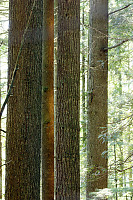
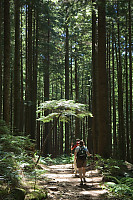
Both composition ideas here are great. It is also worth considering the classic "compressed" tree photos where many trunks placed vertically in the frame create a rhythm. Think Ansel Adams style Aspen photos. Also vertical photos emphasizing the height of the forest with the trunks separated by much negative space is also effective.
Canon-Shooter
Tuesday, December 15th, 2009 at 20:47:18
Absolutely useful tips. Fantastic examples and great pictures. thanks.
jaya
Saturday, July 17th, 2010 at 03:14:29
amazing site...
teja
Saturday, July 17th, 2010 at 11:07:06
thanxx for all the tips...incredible.
dananjee
Friday, July 23rd, 2010 at 08:47:15
I can't believe this! that's fantastic
njonjo
Monday, September 6th, 2010 at 05:12:53
Thanks for the tips. I love to take nature pics and have always been afraid of trees. Now I can take some pics of some trees I've been dying to shoot!!! Thanks again.
dean
Tuesday, January 4th, 2011 at 15:39:30
I have found that the time of day is critical to taking a good tree shot. It depends on the tree which time is best so theres no specific optimal time for it...
noob
Thursday, February 3rd, 2011 at 17:00:31
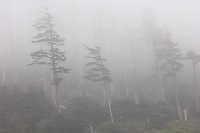
The last one (forest with smoke) is amazing. peaceful, profound and ascending.
David
Thursday, May 12th, 2011 at 06:54:22
Speechless.
Was using part of what is explained and will now go into the depth.
Vineet
Saturday, July 16th, 2011 at 11:34:51
I happen to be looking for photos of trees. when I came across your web site by accident. I love landscapes, particularly forests, trees etc. Your tips are very informative. Thank You.
TONI
Thursday, January 19th, 2012 at 12:44:00
Thanks for sharing and the information!!
I have to say that your comments and the images that go with them made me chuckled. Thank you. I have been wanting to get a great image of a tree, and to my dismay. THEY ARE NOT EASY to photograph, is like the person that can smile normal or closes their eyes every time they hear the shutter go off. they always ruin the shot for you.
Marilyn
Wednesday, October 17th, 2012 at 20:27:25
Very awesome tutorial indeed
Seth
Monday, October 22nd, 2012 at 13:01:43
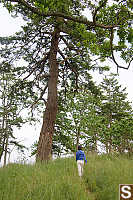
I just sent an SOS to some photo buddies to help me with photographing an immense sycamore that stands alone in a very large area, with no perspective of the size. My comments were so similar to yours (ie: I can't do it justice, the grandness is lost, etc.). Someone suggested that I google the subject and here you are! I might have to place a human at the base of the tree as a last resort, to show its size.
Thanks for the help.
Barbara B.
Tuesday, April 29th, 2014 at 13:17:07