Jaisalmer And Camel Safari

 Three nights, four days wandering the Thar desert
The train from Jodhpur to Jaisalmer
was
late. I
was at the station at 6 something ugly in the morning and the train
didn't
actually arrive until 8:30 - some two plus hours late. There are
no electronic signs with
trains/tracks or times, perhaps a
scratchy announcement (in Hindi) so you are pretty much on your own
to
figure out what's going on. Once on a late train is late it only
gets more late - the train has to wait at sidings for on-time trains to
do their
on-time thing. Perhaps an hour away from Jaisalmer, people came
through the train to "chat" and try and convince us to change hotels to
their "really good" hotel. By the time I arrived in Jaisalmer it
was pretty
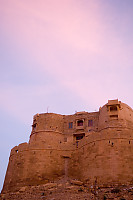
much sunset. The hotel had a roof top deck and we got to enjoy
the sunset falling over the fort. The
beautiful colours made me completely forget about the day on the train.

My hotel (highly rated in every guide book) was full of nothing but
tourists. Different tourists than you seen in Delhi or in the
National Parks - these are younger back packers (or flash packers like
me) who are out to fill their check lists. I booked my camel
safari (4 days, 3 nights) and chatting with people that evening I
found out I was a complete freak - everyone goes for one night.
Uh oh.
The next morning, I loaded into a jeep with a family of 5.
Apparently we were the only people going that morning. We stopped
at two sights - a cenotaph area and a Jain temple before driving down
the remarkably good (military maintained) roads to some place just out
of town. The jeep pulled off the road and there were
camels. We got our bags off the roof and watched while the guides
packed up the camels. They were quick and with very little
coaching, we were on and our camels were munching.
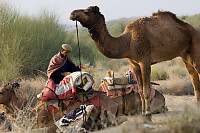
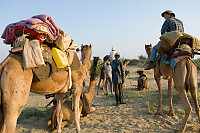
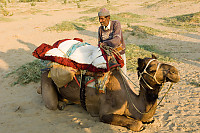
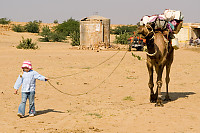
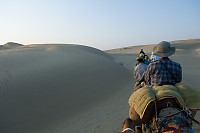
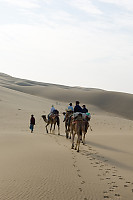
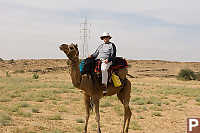
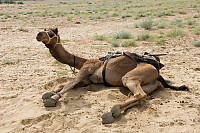
Riding a camel is not like riding a
horse. To
start with the saddle - it's made of wood. They tie blankets over
it, but you will be reminded from time to time, it's wood you are
sitting on. There are no stirrups - you cannot stand up.
There is a horn like a western saddle and you generally use that to
shift your weight around. A horse is generally led by a bit in
it's mouth - a
camel has a piercing in it's nose and I'm sure it hurts like hell when
you move it (let alone tug it). Horses go when you give them a
kick in ribs. Camels need the kick, as well as a verbal que (kind
of a kiss kiss sound) as well as a smack to the neck with the
rope. They will sometimes respond to just one, but if you don't
use all three, they will dull to the input. Famously, camels have
a mind of their own. Sometimes that mind is nice - they
accommodate you and pretty much follow on auto pilot - and sometimes
that mind isn't nice. Final difference - horses you mount while
they
stand. Camels you get on and off of while they sit on the
ground. That transition from sitting to standing has three
motions while the camel gets to its knees and then stands and at one
point you are holding on tightly so you don't fall off.
For our first day, our camels leads were generally held by the guy in
front of you. That nose piercing is an extremely effective
inducement for the camel to follow smartly behind. We rode for
about 1.5 hours to a water stop and then rode another 2 hours until we
got to the edge of sand dunes. This whole area is desert but sand
dunes are actually quite rare.

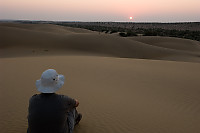
Once at the sand dunes we ran away and played in the sand while our
guides
made us dinner and set up camp. A little sore for the days
walking, we were happy to be over our own feet.
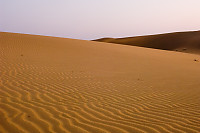
The next morning I dreaded what my bum would
feel like
when it hit that wooden saddle. Breakfast was good - fried egg,
toast and the universal unidentifiable fruit jam they have in
India.
Chai if you wanted it. We packed up (although the guide would do
that for us if we didn't) and the guides got us back in the
saddle. Surprisingly, it didn't feel so bad. We walked
through a Hindu village (they sold Pepsi in bottles) and had lunch in a
fallow field. An hour later we were near a road and our party
split. Annu and I went one way and the family went another.
The family gone, we went on to visit a gypsy
village. I was
surprised to hear the word gypsy - I doubt that is the word they use in
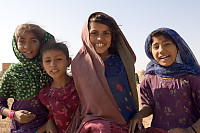
Rajasthani language. The village was mostly filled with kids and
older people - the odd woman. Apparently this village is nomadic
but has been here for months because of a lucrative road building
contract near by. The men and many women were out working and the
children (and there were lots) were left at the camp. The kids,
while obviously poor, understanding digital cameras. From a
childs perspect, digital cameras work thus: First you stand in
front, as cute as possible, and say
picture. Then you run behind to see your picture on the
back of the camera. After seeing the image on the back of the
camera (and
smiling) you say "rupees". Sometimes alot. If you don't get
rupees, try running in front again and posing for a second time.
If that doesn't work, the digital camera must
be broken.
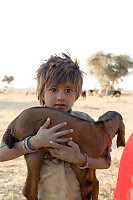
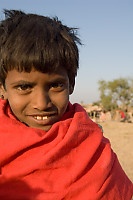
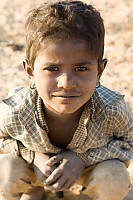
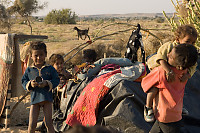
The reality is that these kids are very very
poor. Most will not
see the inside of a school (there are schools in the area, just no
teachers). Almost all of them had runny noses. Many didn't
have pants. Most live in what would be called "tents" and I
really didn't want to understand how sanitation works. Because
these people are generally mobile the state provides very little for
them - other villages we saw did have state provided water services and
sometimes buildings - these people really had nothing.

While I was
entertaining the village kids, my guide had arranged for some of the
members of
the village to come by and perform traditional music and dancing.
We made our camp perhaps a kilometer away.
While my guide was out setting up (gathering firewood) an older
gentlemen with long gun walked into the camp. I was without guide
and a
little surprised (mostly by his very clean Adidas cap) but a quick
namaste from me and his eyes showed he was friendly. When Annu,
my guide, got back they chatted for a while and then started making a
fire. The man was a hunter explained Annu and had had a good
day. He was going to hang out with us for a while.
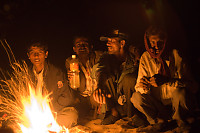
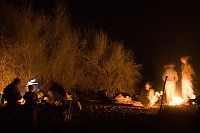
Shortly after dinner the rest of the guides from the trip (who went
with the family) showed up. Moments after that an older gypsy
and two younger women from the village showed up. Somewhere two
bottles of desert whiskey were produced (it tasted like a citrus mixed
with whiskey - it was far from the worst fluid I've drunk) and we
started drinking a little. Annu explained that the booze helps
the performers, but it really seemed to be helping my guides.
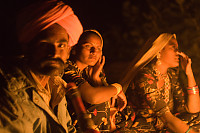
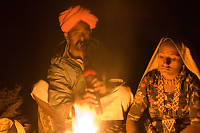
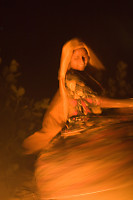
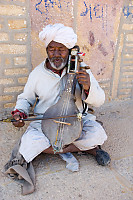
After a bit of a warm up, on of the women got up to dance while the
other sang and the gentlemen played his traditional instrument.
After one song, I was tugged up and danced a song with her (in my
hiking boots). She had a very firm hand on mine and did a pretty
good job of leading.
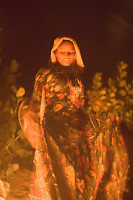
After that, it got depressing. She danced another song while Annu
explained the words - basically it was about a boy getting high before
he went off to fight against the Pakastani's and he was getting high
because he knew he wasn't
coming back. The woman dancing (I'm told was 19 but she looked to
me about 30) was recently married to a 5 year old. This kind of
thing, while illegal, isn't that rare. The family with the
daughter looses a mouth to feed (daughters are effectively borrowed
property from the family she will marry into), and the family with the
son gains more domestic labour. Never mind that this woman will
probably never have children with her husband. And then the
kicker - if I wanted to sleep with this woman, it could be arranged -
these kinds of things happen in the desert. Welcome to the real
India.
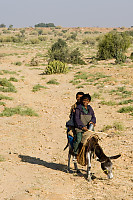
The
next day we made up a plan for the rest of the trip. I basically
had two choices - I could either go to more sand dunes, or I could go
to
more villages. Given that sand dunes all look the same after a
while, I chose villages. We headed off over the range land
and found our way to a Muslim village.
This was much more similar to the Hindu village (permanent) that the
Gypsy village (mobile). There were differences in architecture
and the kids behaved a little different (the boys were more pushy to
get in front of the camera but less concerned about rupees). We
kept on going. After a while I figured out we were actually going
to my
guides family home. His home
is a
large number (like 15) kilometers away from the closest road.
As we got close (it was after when we normally
have lunch) we happened
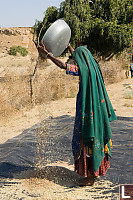
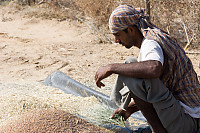
upon a large group of people working. Turns out they were
threshing some sort of desert plant to extract the seed. A group
of perhaps 20 people yielded no more 20 kilograms of seed (which I
believe is a food item) so I hardly saw how this was economical.
A few km further we set up camp and Annu
prepared lunch. I felt a bit useless (it's hard to help cook when
you can't even name the ingredients) so I read for a bit. After
an always good lunch, we went for a walk to his families home.

Annu might see his family once a month when he
is
working (perhaps 8 months of the year - about 1200 rupees a month
before tips, which could increase the total to 2000 rupees -
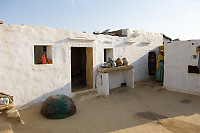
$50CDN). He was quite happy to see them. His parents home
was very simple (no electricity, no running water) but very
clean.
I noticed there were no photos so I offered to take some photos of his
family. His grandparents had no problem but I believe his
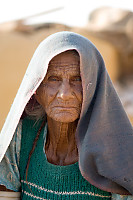
mother (hidden in the corner above - photo taken with permission)
didn't even get asked.
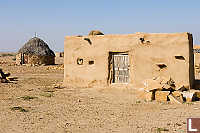
Annu's family live in what was once a village -
they occupy the only home
left. The broken remnants of older homes are now used as pens for
animals not yet old enough to graze. After a bit of touring
and nice glass of chai, we went back to camp. After dinner (an
Egg curry) I told Annu to spend the night with his parents. It
took some convincing (bad feedback from a tourist can lose him his job)
but I believe he was quite happy to go.
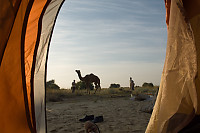
The next morning I got up alone and felt
lots of useless. I finished my book and Annu came back with the
camels. He made me breakfast and we got on with our day. We
walked back the way we came the day before and sat down in a field for
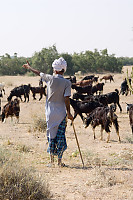
lunch. We watched the human life go by - a goat herder came
through with a large flock of animals grazing on what little
grew. The desert really does have it's own sound.
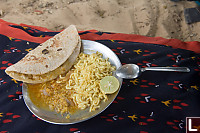
We got to the road, Annu pulled out a cell phone and 15 minutes later I
was in a Jeep heading back to the hotel. I had a really nice long
shower.
I like India food, but at this point (perhaps
a week
of nothing but), I was time for a change. The guide book
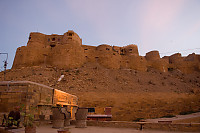
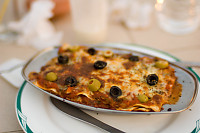
suggested a nice little Italian place just under the walls of the fort
and after buying a book in the marketplace, I had dinner on the patio
while the sun set. The colours and food were both amazing.
My train the next day didn't leave until about 4pm so I had some time
to spend. I took a taxi into town (30 rupies - about 75 cents)
and found a photo development place. The night before I had made
a CD of desert images to so I could give prints to Annu. Turns
out there is no digital lab in Jaislamer (there isn't even power until
11am) so I prepaid for the developing (7 rupies each - about 18 cents a
print) and the prints would be ready in 4 days. I later gave the
slip to the hotel manager (who also runs the Safari's) explained the
situation and hope that it all worked out.
Unlike the other other forts on my trip, Jaisalmers fort is still
occupied. It's the center of city life (many tourist hotels are
inside) so there is lots to see if you walk around inside.
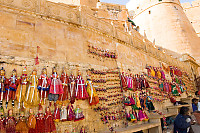
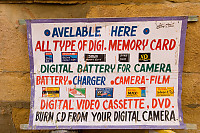
Just below the fort gate is an active vegetable market and a winding
street of Markets. At the same time in Canada my family were
having there Christmas get together and since I would be on a train for
some 19 hours starting the next day, now was the best time to
call. I found a booth and called Canada - almost reasonable
prices - I was amazed.
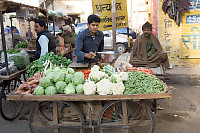

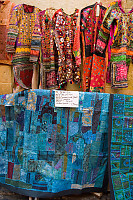
The market areas in India were lovely to
wander. People were friendly, smiled and didn't seem to care I
was there. I believe this city really understands how important
the tourist dollars are and you are probably pretty safe. A good
time had.
Tags: India(45), camel(9), safari(7), portrait(7), performance(7), market(5)
People: John(1)
From: John Harvey Photo > India > Jaisalmer And Camel Safari
From: John Harvey Photo > Trips out of the Country > India > Jaisalmer And Camel Safari
Enjoyed your photos and the narrative from your trip. Provided a glimpse into a part of the world I will never have the occasion to visit. This part of India is very much removed from the "IT meccas" of Bangalore, etc., and your trip story gives us a chance to visit part of India's culture still living the "simple life" while dealing with the complexities of survival.
Thank you !
Jolie
Sunday, April 13th, 2008 at 13:51:37
Great photos and descriptions! I was wondering if you would share the name of your hotel in Jaisalmer. My boyfriend and I are going to Rajasthan and would like to go on the camel safari you went on. Hopefully you receive this comment soon. Thank you!
Kamini
Wednesday, November 4th, 2009 at 12:22:48
I stayed at the "Hotel Shahi Palace". I imagine every trip is unique, but I suspect they will do a good job. I gave them a copy of the photos I took - I wonder if they are still under the glass at the front desk.
I have to say thank you so much for sharing your pictures. They give a great introduction to India and allow for the mind to soar when perhaps the body can't
Annie
Sunday, December 13th, 2009 at 19:51:26
Loved your travel tale. Have been to India a few times myself and planning to go to Jaisalmer on a camel safari in December 2010. It was lovely to read the sincerity of your experience - a true traveler you are. Thank you for sharing. Safe travels.
Elna
Sunday, May 9th, 2010 at 04:38:48
What was the night sky like?
Jenny Bouchet
Sunday, May 23rd, 2010 at 06:53:03
The night sky was not great. India (when I was there) is blanketed by a low level haze - probably from all the fires - cooking, brick making etc. Jaisalmer is pretty large (light pollution source) and there is a large military base near by (also with big lights). I was hoping for stars over dunes but with the haze and nearby lights it didn't happen.
Last Modified Saturday, January 21st, 2023 at 23:44:41 Edit
Copyright and Contact Information.